
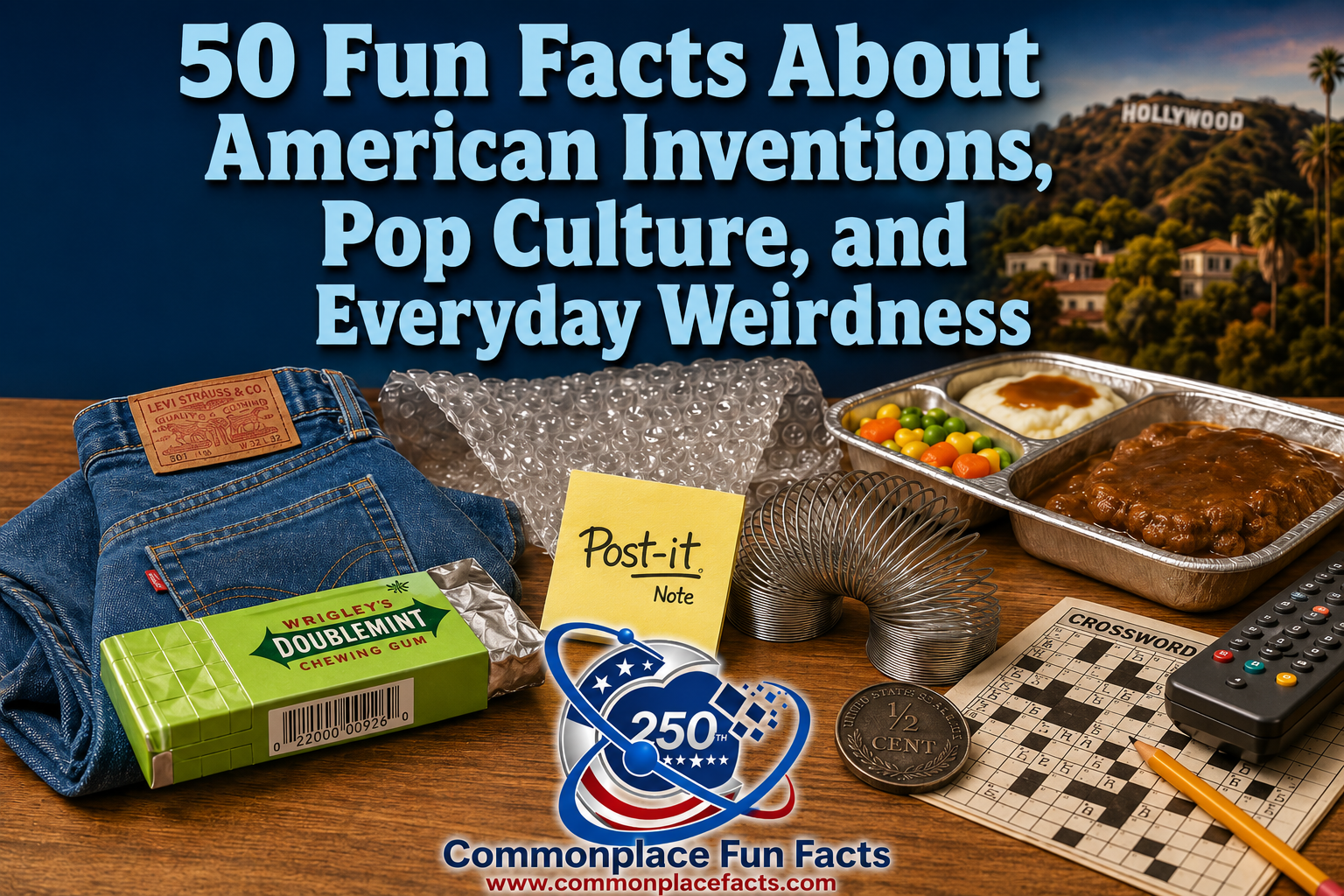

As the United States wraps up its 250th birthday celebrations, it is time to complete our grand tour through the nation’s history, eccentricities, memorable moments, and flashes of accidental genius. We have already covered presidents and politicians, wars and disasters, the 50 states, and animals that shaped American history.
That leaves us with, basically, everything else. And by “everything else,” we mean the inventions, snacks, toys, gadgets, sports, communications breakthroughs, pop culture, oddities, and household items that somehow became part of the American experience. This is the category where someone tries to invent wallpaper and accidentally creates Bubble Wrap. It is where failed glue becomes an office supply. It is where a frozen drink on a stick becomes a childhood institution, and where a game designed to criticize monopolies becomes Monopoly.
In other words, this is the America that happened between the speeches, wars, state nicknames, and bald eagles. It is messy, clever, overmarketed, occasionally brilliant, and often covered in snack crumbs. So, naturally, it belongs here.
Contents
American Inventions and Innovations

- The first U.S. patent was for potash. When people think of American innovation, they tend to imagine the light bulb, the telephone, or the internet. But the very first U.S. patent, issued to Samuel Hopkins in 1790 and signed by George Washington, was for a method of making potash and pearl ash. The American patent system began with industrial chemistry, which is history’s way of reminding us that glory often smells faintly of fertilizer.
- The first telegraph message was “What hath God wrought?” On May 24, 1844, Samuel Morse sent the first official telegraph message from Washington, D.C., to Baltimore. The message came from Numbers 23:23, giving the technology a majestic beginning before humanity eventually used electronic communication to send “LOL” and passive-aggressive calendar invites.
- Blue jeans became famous because of copper rivets. Levi Strauss and Jacob Davis received a patent in 1873 for reinforcing work pants with metal rivets at stress points. That tiny bit of hardware helped turn durable workwear into one of the most iconic garments in the world. Civilization, it turns out, sometimes advances one reinforced pocket at a time.
- The safety elevator made skyscrapers practical. Elisha Otis did not invent the idea of lifting things vertically, but his safety brake made elevators far less likely to become gravity-assisted death closets. In 1854, he famously demonstrated the device by having the hoisting rope cut while he stood on the platform. “All safe, gentlemen,” he reportedly said, because apparently Victorian salesmanship included theatrical near-death demonstrations. Despite this innovation, it was another set of unlikely circumstances that allowed Betty Lou Oliver to survive a 75-story free fall elevator accident when an airplane crashed into the Empire State Building in 1945.
- The first commercial barcode scan was for chewing gum. On June 26, 1974, a package of Wrigley’s Juicy Fruit gum became the first product scanned with a Universal Product Code at a supermarket in Troy, Ohio. Retail history did not begin the barcode age with medicine, machinery, or some grand symbol of commerce. It began with gum, because America understands priorities. Read How Do Barcodes Work? to learn more about the striped little system that quietly runs modern shopping.
- ZIP Codes had a mascot named Mr. ZIP. The Postal Service introduced ZIP Codes in 1963 to speed mail processing. To persuade Americans to actually use them, it promoted a cartoon character named Mr. ZIP, who looked far more excited about mail sorting than anyone has a legal right to be.
- The first 911 call in the United States was placed in 1968. The first U.S. 911 call was made in Haleyville, Alabama, on February 16, 1968. Before that, emergency numbers varied by location, meaning that if you did not already know the right number for that particular locality, you had to look it up in the phone book before summoning help.
- Symbolics.com was the first registered .com domain name. On March 15, 1985, Symbolics.com became the first registered .com domain. That quiet little moment helped inaugurate the online real estate market that would eventually bring us serious business websites, fan forums, shopping carts, and the comments section, which historians may someday classify as a public health concern.
- Mail once traveled through underground pneumatic tubes. Beginning in the 1890s, some American cities used pneumatic tube systems to move mail beneath city streets. Canisters holding hundreds of letters shot through tubes at roughly 35 miles per hour, proving that even envelopes once had a more exciting commute than most of us.
- The cash register was invented partly to keep employees honest. The Ritty brothers of Dayton, Ohio, developed an early cash register called “Ritty’s Incorruptible Cashier.” The name was subtle in the way a locked drawer and a suspicious stare are subtle. It helped business owners track sales and made it harder for clerks and barkeepers to quietly improve their personal compensation plans.
Consumer Culture and Everyday American Life

- Shoppers originally resisted shopping carts. Sylvan Goldman introduced shopping carts in the 1930s, but customers did not immediately embrace them. He reportedly hired models to push carts around the store so shoppers would see that using one was fashionable rather than humiliating. This is one of the rare moments in history when peer pressure improved grocery logistics.
- Sears once sold entire houses by catalog. Between 1908 and the early 1940s, Sears sold mail-order kit homes that arrived by rail with lumber, materials, plans, and instructions. Imagine ordering a house the way people now order replacement phone chargers, except the package weighed several tons and required carpentry.
- The first parking meters were installed in Oklahoma City. Carl Magee developed the parking meter as a response to downtown parking congestion, and the first meters were installed in Oklahoma City in 1935. Thus was born one of the great civic innovations in American life: making you pay for standing still.
- The motel began as the “Mo-Tel.” The Milestone Mo-Tel opened in San Luis Obispo, California, in 1925 as lodging designed specifically for motorists. The word itself came from “motor hotel,” because American language, like American travel, prefers to save time and add neon.
- Air conditioning changed where Americans could comfortably live. Willis Carrier’s development of modern air conditioning in 1902 did far more than cool rooms. It influenced architecture, industry, movie theaters, migration patterns, and the rise of the Sun Belt. It also made July slightly less likely to turn everyone into damp laundry with opinions.
- The modern multipurpose charge card began with Diners Club. Diners Club launched in 1950 as one of the first multipurpose charge cards, allowing members to eat at participating restaurants and pay later. This was a historic financial breakthrough and also the beginning of America’s long, complicated relationship with the phrase “minimum payment due.”
- Early American vending machines sold gum. Vending machines debuted in the United States in 1888 when the Thomas Adams Gum Company placed machines on New York City subway platforms. They dispensed gum, which is perhaps the most American possible first step toward a world where machines now sell everything from coffee to earbuds to questionable airport sandwiches.
- The first wireless TV remote used light. Zenith introduced the Flash-Matic wireless remote in 1955. It used a directional beam of light aimed at sensors in the corners of the television screen. This was revolutionary, although sunlight could occasionally interfere, ensuring that the family’s youngest child remained secure in the role of official remote channel turner.
- TV dinners helped turn the living room into a dining room. Swanson’s frozen dinners became famous in the 1950s, and one widely accepted origin story involves hundreds of tons of leftover turkey after Thanksgiving. The solution was to put meals in compartmentalized trays and let Americans eat while watching television. It was not fine dining, but it did have structure, which is more than can be said for many family dinners.
- The first Academy Awards ceremony lasted about 15 minutes. The first Oscars were held in 1929 at the Hollywood Roosevelt Hotel. The ceremony lasted around 15 minutes, which modern awards shows regard as the first draft of a single acceptance speech.
Food, Snacks, and Edible American Problem-Solving

- Graham crackers began with a health reformer. Graham crackers are named after Sylvester Graham, a nineteenth-century minister and dietary reformer who promoted plain whole-grain foods. The modern graham cracker, especially when paired with chocolate and marshmallows, would probably have made him reach for smelling salts.
- Corn flakes came from health-reform culture, not cartoon tigers. John Harvey Kellogg and the Battle Creek health movement helped popularize breakfast cereal as a health food. Eventually, cereal wandered away from the sanitarium and into the arms of sugar, mascots, and Saturday morning cartoons, as many reform movements do.
- The Popsicle was invented by an eleven-year-old. The popular story says Frank Epperson accidentally left a mixture of soda powder and water outside overnight with a stirring stick in it in 1905. It froze, and the ice pop was born. Most childhood accidents produce stains, broken lamps, or medical co-pays. This one produced dessert.
- Tater Tots were born from potato scraps. Ore-Ida’s founders developed Tater Tots as a way to use leftover potato pieces from French fry production. This is the kind of waste-reduction story Americans can support because it involves deep frying and minimal moral effort.
- Buffalo wings turned a discarded chicken part into bar-food royalty. The most famous origin story credits Teressa Bellissimo of Buffalo’s Anchor Bar with creating Buffalo wings in 1964. The details vary, because food origin stories are where certainty goes to marinate, but the result is undeniable: millions of Americans now willingly coat their fingers in sauce and call it dinner.
- Ranch dressing began at Hidden Valley Ranch. Steve Henson developed the dressing that later became ranch, serving it at Hidden Valley Ranch in California before the recipe was sold and commercialized. It has since escaped salad and now appears on wings, pizza, fries, vegetables, and any other food that looks insufficiently American.
- Jell-O became a hit through aggressive marketing. Jell-O’s rise owed much to advertising, recipe booklets, and a determined campaign to convince households that gelatin could be both dessert and architecture. If you have ever seen vegetables suspended in lime gelatin, you have witnessed optimism losing a knife fight with texture.
- Candy corn was once marketed as “Chicken Feed.” Candy corn was originally sold under the name “Chicken Feed,” aimed at a country still deeply connected to agricultural life. Today it is mostly used to divide families into two hostile camps: those who eat it and those who believe it was manufactured as an attack on civilization.
- Girl Scout Cookies started as local baking projects. The Girl Scout Cookie tradition began in 1917 when the Mistletoe Troop in Muskogee, Oklahoma, baked and sold cookies to raise money. From there, it grew into a national seasonal economy powered by badges, clipboards, parental guilt, and the unstoppable force of Thin Mints.
- German chocolate cake is not German. The layered cake with coconut-pecan frosting traces back to a 1957 Dallas recipe by Mrs. George Clay, who called it “German’s Chocolate Cake” because it used Baker’s German’s Sweet Chocolate, named for Samuel German. As the cake spread, the apostrophe wandered off, and suddenly people assumed the dessert came from the land of sausages and sauerkraut. It did not. It came from Texas.
Toys, Games, and Accidental Joy

- Play-Doh began as wallpaper cleaner. Before it became a childhood staple, Play-Doh was a compound used to clean soot from wallpaper. When coal heating declined, the product needed a new purpose. Children supplied one by enthusiastically mashing it into shapes that adults would later find in carpet fibers.
- The Slinky came from a falling spring. Naval engineer Richard James noticed a spring “walking” after it was knocked from a shelf, eventually leading to one of America’s most recognizable toys. This is encouraging news for anyone whose best ideas also begin with dropping something.
- Silly Putty came from wartime rubber-substitute research. Chemist James Wright created the material while looking for a rubber replacement during World War II. It did not solve the rubber shortage, but it did bounce, stretch, and copy newspaper comics, which is a strangely respectable second act.
- Bubble Wrap was originally supposed to be wallpaper. In 1957, Alfred Fielding and Marc Chavannes set out to create textured wallpaper by sealing plastic sheets together with air bubbles inside. The wallpaper idea failed, but the material became one of the world’s great packaging inventions and humanity’s most socially acceptable form of stress relief.
- Post-it Notes came from glue that was not sticky enough. 3M scientist Spencer Silver was trying to make a strong adhesive and instead created one that stuck lightly without bonding tightly. Years later, Art Fry found a use for it as a removable bookmark, and the office world gained a tiny yellow rectangle capable of carrying both reminders and judgment.
- The Hula Hoop became a national craze in 1958. Wham-O sold millions of Hula Hoops in a matter of months. America briefly united around the idea that dignity was optional if a plastic circle was involved.
- The Frisbee has pie-tin ancestry. The story of the Frisbee traces through flying lids, pie tins, and plastic discs before becoming a Wham-O classic. Walter Frederick Morrison developed the Pluto Platter, which Wham-O later renamed the Frisbee after learning that college students were already using the term, inspired by Frisbie Pie Company tins. Few inventions have done more to give college students, beachgoers, and golden retrievers a sense of purpose.
- Barbie and Ken were named after real people. Ruth Handler named Barbie after her daughter Barbara and Ken after her son Kenneth. This means one of the most famous fictional couples in toy history was named after real-life siblings, a fact best handled quickly and then placed gently back on the shelf.
- Monopoly grew out of an anti-monopoly game. Lizzie Magie created The Landlord’s Game to criticize monopolies and illustrate economic ideas. It eventually evolved into Monopoly, a game in which families spend hours cheerfully bankrupting one another over real estate. Satire rarely gets to live long before someone monetizes it.
- Scrabble was invented by an unemployed architect. Alfred Mosher Butts developed the word game that eventually became Scrabble during the Great Depression. He combined crossword-style play with letter-frequency analysis, giving Americans a way to weaponize vocabulary during family gatherings. We will refrain from commenting on someone named Butts being particularly interested in spelling.
Pop Culture, Sports, Money, and Other National Oddities

- The Hollywood sign began as a real-estate advertisement. The famous sign originally read “HOLLYWOODLAND” and was erected in 1923 to promote a housing development. It was supposed to be temporary, which is always a dangerous thing to say around landmarks, traditions, and things with large budgets.
- The Wilhelm scream became Hollywood’s most famous recycled yell. The Wilhelm scream originated as a stock sound effect from the 1951 film Distant Drums and was later reused in hundreds of films and television shows. If you have watched enough action movies, you have heard one man suffer across multiple universes.
- The laugh track taught television audiences when jokes had occurred. Sound engineer Charley Douglass pioneered the use of recorded laughter to “sweeten” television comedy. This gave sitcoms a built-in crowd response and spared viewers the crushing responsibility of deciding for themselves whether a joke had landed.
- The first Super Bowl was not officially called the Super Bowl. The first AFL-NFL championship game was played in January 1967 and was not yet officially known by the name that would become a national institution. It later became Super Bowl I, because history sometimes needs a rebrand after kickoff.
- Basketball began with peach baskets. James Naismith invented basketball in 1891 using a soccer ball and peach baskets nailed ten feet above the floor. At first, someone had to retrieve the ball from the basket after each score, which means early basketball had both strategy and built-in delays for reflection.
- Volleyball was originally called “mintonette.” William G. Morgan invented the game in 1895 as a less physically punishing alternative to basketball. Its original name, “mintonette,” was later replaced by “volleyball,” saving generations of athletes from having to say they made varsity mintonette.
- Abner Doubleday is famous for the wrong American pastime. According to the old Cooperstown legend, Doubleday invented baseball in a cow pasture in 1839. The problem is that historians generally do not buy it, which is inconvenient for everyone except people who enjoy ruining plaques. What Doubleday unquestionably did do was fire the first Union shot in response to the Confederate bombardment of Fort Sumter on April 12, 1861. He later fought at Gettysburg and called himself the “Hero of Fort Sumter,” but history mostly remembers him for a game he probably did not invent. In other words, he really did go to bat for the United States — just with artillery.
- The first crossword puzzle was published in 1913. Arthur Wynne’s “word-cross” puzzle appeared in the New York World on December 21, 1913. It helped launch a national puzzle craze and gave newspapers another way to make readers feel either brilliant or personally attacked by four-letter words.
- The United States once had a half-cent coin. The half cent was minted from 1793 to 1857 and was worth exactly what it sounds like: half a cent. It is a reminder that inflation has been quietly standing in the corner, smirking, for a very long time.
- America’s everyday weirdness may be its most reliable historical product. Over 250 years, the country produced founding documents, political institutions, national parks, railroads, moon missions, and all the serious things school textbooks are contractually obligated to mention. But it also produced barcode gum, potash patents, ranch dressing, mail torpedoes, sticky notes, Bubble Wrap, and a cash register literally named the Incorruptible Cashier. That, in its own strange way, is the American story: big ideals, practical problems, accidental inventions, aggressive marketing, and snacks.
The Final Word on 250 Years of Fun Facts
This concludes our five-part series of 250 fun facts about America’s heritage. We have met presidents with strange pets, states with suspiciously specific claims to fame, military plans that needed adult supervision, heroic animals, accidental inventions, peculiar foods, and toys that began life as cleaning supplies or engineering mistakes.
It would be tempting to wrap the whole thing in solemn patriotic language. There is a place for that. But there is also something deeply American about admitting that the same country that produced the Constitution also produced candy called Chicken Feed, a postal mascot named Mr. ZIP, and a plastic hoop that briefly convinced millions of adults to gyrate in public.
America’s history is not just a parade of speeches, battles, elections, and monuments. It is also a long-running experiment in invention, reinvention, commercialization, improvisation, and occasionally asking, “What if we deep-fried the scraps?”
Happy birthday, USA!
You may also enjoy…

50 Fun Facts About Presidents and Politicians That Sound Made Up (But Aren’t)
Discover 50 surprising fun facts about presidents and politicians that sound unbelievable—but are completely true. From duels to pet raccoons, history is stranger than fiction.

50 Fun Facts About American History: Wars, Disasters, and Decisions That Probably Needed a Second Meeting
Explore 50 weird, wonderful, and slightly embarrassing fun facts about American history, including strange wars, bizarre military plans, disasters, nuclear scares, and decisions that definitely needed a second meeting.

50 Fun Facts About Animals That Shaped American History
Here are 50 fun facts about animals that shaped American history, from the bald eagle and Sergeant Stubby to Balto, Smokey Bear, spy cats, and goat mayors.




Leave a Reply