
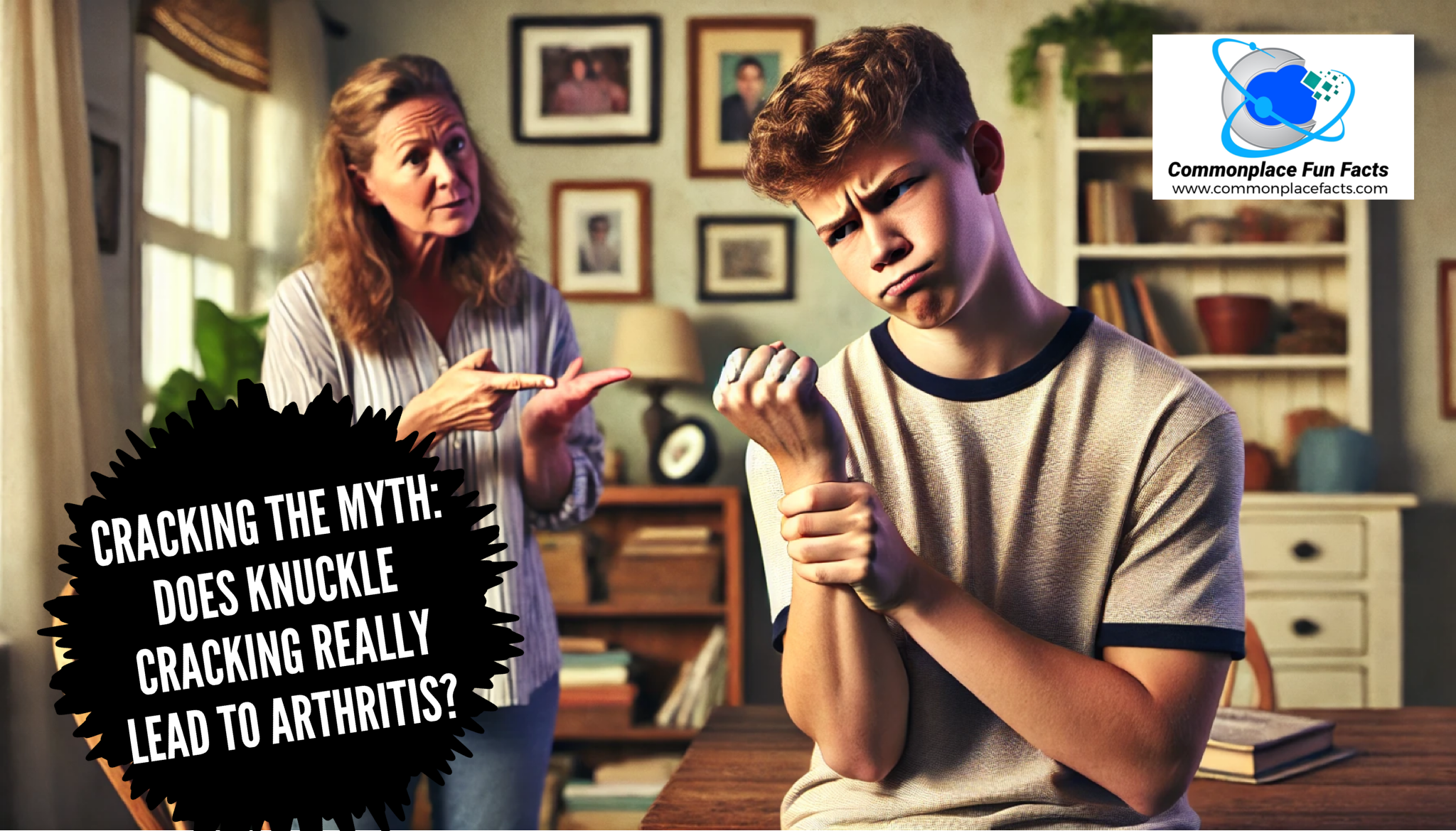

You’ve heard it before, probably as you happily snapped your knuckles, feeling all smug and limber. Someone leans over, offering unsolicited wisdom about your knuckle cracking: “You keep doing that, and you’ll end up with arthritis!” Cue ominous music, perhaps followed by a solemn shake of the head. It’s a claim so ingrained in popular culture that even the faintest knuckle pop in a quiet room might send a wave of concerned looks your way. Everyone knows that cracking knuckles is one of the primary arthritis causes, right?
But, my friend, it’s time to loosen those joints and give that old myth a good crack. Literally.
A Quick Dip into Biological History: No Knuckle-Walking, But a Whole Lot of Knuckle-Cracking
Before we dive into debunking, let’s take a step back—or perhaps a knuckle crack back—into the biological record. The latest physical anthropology research tells us that the humans never experienced a knuckle-walking phase. Admittedly, there were a couple of mouth-breathers in high school who looked like knuckles-draggers. In reality, we do not share that trait with our primate cousins. We, however, did enter a knuckle-cracking phase somewhere along the way, and it seems we have yet to exit it.
Find out where a knuckle of John the Baptist can be located.
If we had a nickel for every time we’ve seen a musician crack their knuckles before even daring to play a note, we wouldn’t have to pander for advertising to support the Commonplace Fun Facts coffee budget. We might run out of knuckles (including those on our feet) trying to count how many of us limber up for everything from sports to typing by playing a quick xylophone riff on our joints. Despite the wide popularity of this harmless habit, someone will inevitably tell you, with full conviction (and probably a cup of chamomile tea in hand), that this will lead to arthritis. Let’s classify this as a health myth and put that amateur theory to rest.
Donald Unger: The One-Man, Two-Hand Experiment
Enter one Donald Unger, a physician who took this myth personally. Unger didn’t just roll his eyes at well-meaning family members who swore knuckle cracking would doom him to arthritis; he launched a half-century-long scientific investigation. For fifty years—yes, you read that right—he cracked the knuckles on his left hand at least twice a day, but left his right hand knuckles untouched, acting as a control. That’s at least 36,500 cracks for one hand, if you’re doing the math.
Unger published his work, cleverly titled “Does Knuckle Cracking Lead to Arthritis of the Fingers?” in the Journal of Arthritis & Rheumatism in 1998. His findings? No arthritis in either hand, no significant differences between the two, and probably no more unsolicited medical advice from family gatherings.
The scientific community took notice—not just for his results, but for his dedication. In 2009, he was awarded an Ig Nobel Prize in Medicine. If you’re unfamiliar, the Ig Nobels are presented annually by the good folks at Improbable Research for “achievements that first make people laugh, and then make them think.” And let’s be real, fifty years of cracking one hand’s knuckles while resisting the other? That deserves both a chuckle and a round of applause (sans cracking sounds, if possible).
The Evidence Piles On: No Crack in the Case for Arthritis
You’d think Unger’s monumental effort would have settled the score, but this isn’t the first time scientists (or, in some cases, their sons) tackled this myth. Robert Swezey, another M.D., tried to put an end to this knuckle-cracking kerfuffle way back in 1975, even roping in his 12-year-old son to help debunk the myth for grandma. And, just like Unger, Swezey found no evidence that cracking your knuckles would lead to arthritis.

But, of course, even scientific studies are not immune to the snark of their peers. Rand Corporation statistician John Adams, in his response to the Unger study, pointed out one glaring oversight: the lack of blinding in the experiment. “Blinding would only be possible,” he noted dryly, “if the investigator didn’t know left from right. This is not likely since studies indicate that only 31 percent of primary care physicians don’t know left from right.” Ouch. Score one for scientific sarcasm.
A Crack Team of Fourth Graders and Nursing Home Residents
The knuckle-cracking myth caught the attention of Stanford University bone expert David Kingsley when his son’s fourth-grade class decided to take on the issue. One enterprising kid suggested an intervention study: half the class could crack their knuckles like it’s going out of style, and the other half could abstain. They’d wait twenty years to see what happened. Kingsley agreed it was a great idea, though there was the minor issue of waiting a couple of decades for results.
Instead, they turned to existing studies, which found that researchers had already asked the knuckle-cracking question of those who’d had time to build up a lifetime of pops—nursing home residents. Two studies, including Swezey’s, found that neither the elderly nor the outpatient knuckle crackers showed any higher incidence of arthritis than their non-cracking counterparts.
The Bottom Line: Crack Away, Friends
So, there you have it. Donald Unger, Robert Swezey, and even a team of fourth-graders have all shown that your love of cracking knuckles isn’t going to leave you with aching joints in your old age. The myth that cracking knuckles leads to arthritis is just that—a myth. Feel free to crack your way through life without fear, although maybe avoid doing it during meetings, or you’ll get judgmental glares for reasons unrelated to arthritis.
Let’s give Dr. Unger a big (cracked) hand for his dedication. Thanks to his tireless knuckle-popping, we can all crack on without worrying about our joints rebelling against us. But should your family insist you stop, at least you’ve got the science—and the Ig Nobel Prize committee—on your side.
You may also enjoy…

Does France Always Surrender? Exposing the Surprising Truth Hidden Behind Musket Smoke
Think France always surrenders? Think again. This deep dive into French military history debunks the surrender myth with facts, battles, and a whole lot of musket smoke.

Busting the Myth: Can You Teach An Old Dog New Tricks?
Discover whether you can teach an old dog new tricks and find out why the old saying is all bark and no bite. Backed by science and served with humor, this myth-busting article proves age is just a number—even for dogs!

Cow Tipping 101: Myth-Busting the Moo
Discover the truth behind the myth of cow tipping! This humorous and fact-filled article explores the science, folklore, and pop culture behind one of rural America’s most enduring (and impossible) legends.






Leave a Reply