
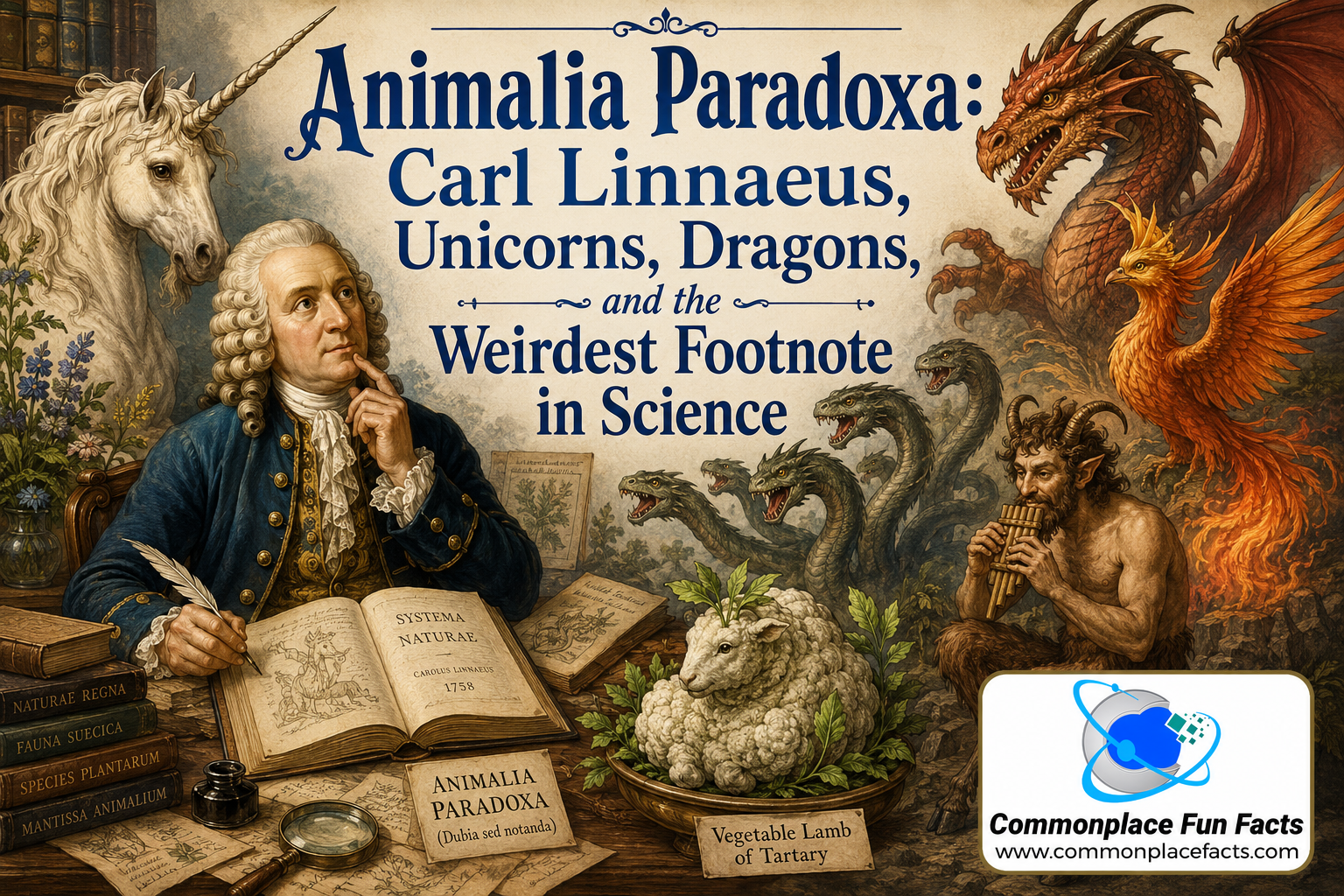

Carl Linnaeus is remembered as the father of modern taxonomy, which is the educated way of saying he was the man who looked at all of creation and said, “This needs labels.”
Plants? Label them. Animals? Label them. Humans? Definitely label them, although that part would get awkward for reasons that belong in a different article and at least one uncomfortable Supreme Court confirmation hearing. Linnaeus wanted nature sorted, organized, and categorized according to observable characteristics. He gave us binomial nomenclature, the two-name system by which living things receive their official Latin-ish stage names. Homo sapiens. Panthera leo. Tyrannosaurus rex. Thanks to Linnaeus, nature now has a filing cabinet.
There was, however, one small problem.
People kept insisting on dragons.
Not just dragons, either. Unicorns. Phoenixes. Satyrs. Hydras. Birds that grew from barnacles. A plant that supposedly grew a lamb. A mysterious ticking insect in the wall that people associated with impending death, because apparently the 18th century did not already have enough problems associated with insect infestations.
Linnaeus did what any serious scientist would do when confronted with a stack of dubious monster reports, medieval folklore, traveler exaggerations, and possibly a taxidermist with boundary issues: he made a special category for them.
He called it Animalia Paradoxa.
In English, that means something like “contradictory animals” or “paradoxical animals.” In practical terms, it meant, “Creatures people keep talking about, but which nature has not yet had the courtesy to produce in front of sober witnesses.” It was the scientific equivalent of a junk drawer, except instead of old batteries and takeout menus, it contained unicorns, dragons, and a lamb that grew on a stem.
Contents
The Man Who Tried to Alphabetize Creation
Carl Linnaeus was born in Sweden in 1707 and became one of the most important naturalists in history. His great work, Systema Naturae, first published in 1735, attempted to classify the natural world into an orderly hierarchy. Kingdoms, classes, orders, genera, species — everything had its place. It was ambitious, elegant, and exactly the sort of thing one might expect from a man who looked at the chaos of life on Earth and thought, “What this needs is more Latin.”

The genius of Linnaeus was not merely that he named things. Humans had been naming animals for a long time, frequently with unflattering words after being chased by them. Linnaeus’s innovation was consistency. He wanted organisms classified according to shared traits and placed into a logical system. That system was not perfect, and later science has revised it dramatically, especially with genetics showing up and ruining everyone’s tidy assumptions.
Still, Linnaeus gave biology a framework. He helped move natural history away from rumor, symbolism, and tradition, and toward description, comparison, and evidence.
Which brings us back to the dragons.
Welcome to Animalia Paradoxa, Nature’s Rejected Applications Folder
The first editions of Systema Naturae included a section called Animalia Paradoxa. These were animals that appeared in older books, folklore, traveler accounts, medieval bestiaries, and cabinets of curiosities, but which Linnaeus believed were either exaggerated, misunderstood, fraudulent, or just plain imaginary.

This is important: Linnaeus was not saying, “Here are some cool monsters I would like to officially recognize.” He was not inventing creatures from whole cloth, like our wonderfully creative friend Sopantooth did with the griddle mermaid. Linnaeus was saying, in effect, “People keep bringing these up, so let us deal with them before someone tries to assign a genus to a campfire story.”
The list included such biological overachievers as the hydra, the unicorn, the satyr, the phoenix, the dragon, the Vegetable Lamb of Tartary, the barnacle goose myth, and the ominous deathwatch beetle. Some were completely imaginary. Some were real animals misunderstood through folklore. Some were fake specimens assembled by human hands, which was the 18th-century method of cheating on biology projects before ChatGPT was invented.
Animalia Paradoxa is fascinating because it sits right on the border between medieval imagination and modern science. It shows us a world in transition. On one side stood centuries of bestiaries, moral allegories, sailors’ tales, religious symbolism, and the ancient human instinct to see something weird and immediately make it weirder. On the other side stood observation, classification, skepticism, and the developing scientific method.
Linnaeus did not remove wonder from nature. He removed the parts that had been stapled on by rumor.
The Hamburg Hydra: Seven Heads, Zero Credibility
The most famous creature connected with Linnaeus’s monster investigations was the Hamburg hydra.
This alleged beast was a many-headed serpent, supposedly resembling the dragon-like creature from the Book of Revelation. It had seven heads, a snake-like body, and enough theatrical presence to be permanently cast as the bad guy in any Godzilla movie.
The specimen had a glamorous and suspicious history. It was said to have been taken from a church after the Battle of Prague in 1648 and eventually ended up in Hamburg. By the time Linnaeus saw it in 1735, it was in the possession of Hamburg’s mayor, who hoped to sell it for a very large sum of money.
Linnaeus got a close look.
That was bad news for the hydra.

He concluded that the creature was a fake. The supposed monster had been assembled from parts of actual animals, including snake skins and weasel-like components. The teeth were a particular giveaway. Nature, Linnaeus pointed out, did not produce many heads on one body as a normal zoological arrangement. Also, the hydra’s craftsmanship apparently failed to withstand the scrutiny of a man who knew what teeth belonged in which mouth.
In other words, the Hamburg hydra was less “terrifying beast from apocalyptic prophecy” and more “craft project with a marketing budget.”
Linnaeus’s exposure of the fraud did not make him universally popular in Hamburg. One does not casually announce that the mayor’s expensive monster is a snake-weasel taxidermy scam and expect everyone to clap politely. Debunking mythology is noble work, but it rarely improves one’s invitation list.
Still, the episode perfectly captures Linnaeus’s role. He did not simply dismiss the hydra from a distance. He examined it. He compared it to known anatomy. He identified the fraud. Then he put it in the scientific reject pile, where it could sit quietly and think about what it had done.
The Unicorn Was a Whale Tooth With Better Public Relations
The unicorn also appeared in Animalia Paradoxa. No respectable monster-adjacent catalog is complete without the unicorn, the elegant horse-like creature with a single spiraled horn and centuries of branding power, even rising to the status of being Scotland’s official animal.

Linnaeus was not impressed.
The problem with unicorns was not that no one had ever seen a horn. Plenty of people had seen “unicorn horns.” The issue was that these horns generally came from narwhals, which are real Arctic whales with long spiral tusks. A narwhal tusk is a remarkable object. It is long, straight, twisted, mysterious, and exactly the sort of thing medieval Europeans were willing to believe had come from a magical horse instead of a marine mammal with dental ambition.
This is how myths often work. A real object enters a culture without its full context, and imagination does the rest. Narwhal tusks became unicorn horns. Unicorn horns became prized objects. Prized objects became medicine, magic, royal decoration, and the sort of thing collectors used to prove they were both wealthy and dangerously credulous.
Linnaeus accepted the narwhal. The narwhal was observable. It had a body, habitat, anatomy, and inconveniently whale-like behavior. The horse with the forehead spear, however, did not fare as well.
The unicorn, in this sense, was not entirely born from nothing. It was born from misunderstanding. Someone saw a whale tooth and hired a horse.
The Pelican and the Blood-Feeding Myth
Skepticism in science is healthy and commendable. It can also result in dismissing some things prematurely.
One of the stranger entries in Animalia Paradoxa is the pelican. This may seem unfair. Pelicans are real birds. They exist. They fly, fish, and look like someone designed a bird around a grocery bag. Why would Linnaeus place a real bird anywhere near unicorns and hydras?
The answer lies in the myth attached to the pelican, not the bird itself.

For centuries, people believed that pelicans wounded their own breasts to feed their young with blood. This image became especially powerful in Christian symbolism, where the self-sacrificing pelican represented Christ. Medieval art and literature loved this image. It was dramatic, morally resonant, and completely unnecessary from the pelican’s point of view.
Linnaeus rejected the blood-feeding story. The real explanation probably involved misunderstanding the pelican’s large pouch and feeding behavior. A pelican bending down to feed its chicks may look, from a distance and with sufficient medieval enthusiasm, as if it is piercing its own breast. Add symbolism, repeat for a few centuries, and suddenly an ordinary bird becomes a feathered sermon illustration.
The pelican was not fake. It was merely the victim of medieval public relations.
This is one of the most interesting things about Animalia Paradoxa. Not every entry was purely imaginary. Some were real animals carrying fictional baggage. Linnaeus was not just separating real from unreal. He was separating animals from the stories humans had draped over them like badly fitted costumes.
Satyrs, Apes, and the Perils of Squinting at Nature
The satyr was another creature in Linnaeus’s suspicious category. In classical mythology, satyrs were wild, lustful, human-animal hybrids associated with forests, wine, and the general collapse of respectable behavior. Satyrs lived in the forest, were part man, part beast, and entirely unsuitable for polite company. Basically, a fraternity on a camping trip.

Linnaeus treated the satyr not as a mythological woodland party hazard but as something that might have been inspired by apes or monkeys. This was a reasonable move. Reports of humanlike hairy creatures from distant lands often reached Europe filtered through rumor, exaggeration, mistranslation, and an astonishing willingness to draw conclusions before lunch. The word “gorilla” originated from the belief of early explorers that they had seen a tribe of large, hairy women.
To Europeans unfamiliar with many primates, an ape could seem disturbingly human. It had hands. It had facial expressions. It moved in ways that felt uncomfortably close to us. Add a traveler’s account, a few artistic liberties, and the ancient human desire to populate the edges of the map with deeply questionable beings, and the satyr starts to look less like zoology and more like anthropology after a few drinks.
Linnaeus’s handling of the satyr shows his cautious approach. He did not simply say, “Impossible” and move on to the next entry. He asked what real animal might stand behind the story. That distinction matters. The scientific question was not, “Could mythology be true?” It was, “What observation or misunderstanding produced this myth?”
That question remains useful. It is also a good thing to ask whenever someone begins a sentence with, “Well, they’re saying on the internet that…”
The Dragon: A Lizard With Delusions of Grandeur
The dragon has one of the longest résumés in monster history. It appears across cultures in various forms: serpent, giant reptile, winged beast, fire-breather, treasure-hoarder, princess-inconveniencer, and general medieval zoning violation. Nature even warned that the supposedly-extinct dragons could be making a comeback because of global warming.

Linnaeus did not accept dragons as real animals. He suggested that supposed dragon specimens were likely artificial creations, perhaps made from lizards, rays, or other animal parts that had been dried, altered, and displayed as wonders.
This was not far-fetched. Early modern collectors loved strange specimens. Some were genuine natural curiosities. Others were assembled by enterprising fraudsters who understood a timeless principle: people will pay more to see a monster than a regular fish.
So-called “dragons” could be made by manipulating dried animals. Rays, in particular, were sometimes altered into grotesque little figures. With enough cutting, stretching, drying, and entrepreneurial shamelessness, a perfectly innocent sea creature could be transformed into something that looked like it might demand tribute from a village.
This was the age of cabinets of curiosities, where natural history, art, science, superstition, and carnival showmanship often shared the same shelf. Linnaeus was trying to bring order to that world. He was not opposed to wonder. He was opposed to being asked to classify someone’s souvenir taxidermy prank as a legitimate species.
The Vegetable Lamb of Tartary, Because Apparently Plants Needed Livestock
Of all the entries in Animalia Paradoxa, the Vegetable Lamb of Tartary may be the most magnificently ridiculous.
The legend claimed that somewhere in Central Asia grew a plant that produced a living lamb. Depending on the version, the lamb was attached to the plant by a stalk or umbilical stem. It grazed on the surrounding vegetation until it had eaten everything within reach, at which point both plant and lamb died. Wolves supposedly loved eating it, because even legendary predators apparently appreciate farm-to-table dining.
This creature was also known as the Scythian Lamb or Borometz. It occupied the thrilling intersection of botany, zoology, folklore, and “Did anyone write this down before the fever broke?”

The Vegetable Lamb probably grew out of distorted reports about cotton plants, wool, ferns, and strange root forms. In some cases, fern rhizomes were shaped or interpreted to resemble small animals. People who had never seen cotton growing might hear that wool came from a plant and assume the plant grew sheep, because why not take the scenic route to misunderstanding?
Linnaeus dismissed the Vegetable Lamb as an artificial or misunderstood object rather than a real organism. This was wise, because if plants could grow livestock, agriculture would have taken a very different turn, and salad bars would require electric fencing. It would also create interesting debates about whether a vegan could eat lamb chops.
The Vegetable Lamb is funny because it is absurd. It is also revealing. It shows how difficult natural history could be in an age when information traveled slowly, specimens were rare, and secondhand reports gained authority simply by surviving long enough to be copied into another book.
Some myths are not invented all at once. They accrete. A strange plant here, a traveler’s description there, a mistranslation, an illustration, a collector, a scholar repeating an older scholar, and suddenly Europe is discussing shrubbery that gives birth to mutton.
The Phoenix and the Problem of Overdramatic Reproduction
The phoenix, according to ancient legend, was a magnificent bird that lived for centuries, died in flames, and rose again from its own ashes. It is a beautiful image. It is also, from a zoological standpoint, a reproductive strategy with several unanswered questions.

Linnaeus included the phoenix among the paradoxical animals and rejected the idea of a literal bird renewing itself by self-cremation. This was another case where ancient symbolism had wandered into natural history and needed directions back to mythology.
The phoenix has always been more powerful as a symbol than as a bird. It represents rebirth, immortality, renewal, and the hope that destruction is not the end. That is lovely. It is meaningful. It belongs in poetry, religion, heraldry, and motivational posters hanging in office break rooms.
It does not belong in a scientific classification of birds.
This is one of the great services Linnaeus performed. He helped separate symbolic truth from biological fact. A phoenix may tell us something profound about human longing, but it tells us very little about avian anatomy, unless the lesson is “do not nest in fire.”
The Barnacle Goose: When Migration Looked Like Magic
The barnacle goose myth is one of those stories that sounds impossible until you remember how much of nature was genuinely mysterious before modern science.

People in parts of medieval and early modern Europe believed that barnacle geese were generated from barnacles attached to driftwood. The idea seems bizarre now, but it arose from an understandable gap in observation. Barnacle geese breed in the Arctic. People in warmer regions saw the birds appear seasonally but did not see their nests, eggs, or young. They also saw goose barnacles attached to floating wood, with feathery-looking appendages that, if one were feeling imaginative and perhaps overdue for a nap, might vaguely resemble emerging birds.
Thus the conclusion: geese grow from barnacles.
This was convenient for several reasons, including religious dietary rules. If a goose came from a barnacle rather than ordinary animal reproduction, perhaps it counted as fish and could be eaten during fasting periods. Nothing says theological rigor quite like classifying poultry as seafood because dinner is inconvenient.
Linnaeus rejected the barnacle-goose transformation. Birds come from eggs. Barnacles are crustaceans. Driftwood is not a maternity ward. These are the sort of distinctions science insists upon, even when they ruin lunch.
The barnacle goose myth is a wonderful example of how human beings explain gaps in knowledge. When we do not know where something comes from, we invent a bridge. Sometimes the bridge is elegant. Sometimes it is barnacle poultry.
The Deathwatch Beetle: The Grim Reaper in Your Woodwork
Not every entry in Animalia Paradoxa was a grand mythical beast. One of the creepiest was associated with the deathwatch beetle.

The deathwatch beetle is a real insect. It bores into wood, and adults produce tapping sounds, especially during mating behavior. In quiet houses, particularly during long vigils beside the sick or dying, people heard the tapping from walls or furniture and interpreted it as an omen of death.
This is understandable in the way many superstitions are understandable. Imagine sitting in a dim room, watching over a dying relative, hearing a mysterious tick-tick-tick from inside the walls. You do not know about beetle mating signals. You do know that everyone is sad, the candles are low, and the house appears to be counting down. The human brain, never one to miss a chance to make things worse, supplies the rest.
In reality, the ominous tapping was not Death approaching.
It was beetle Tinder.
Again, the natural explanation is not less strange than the supernatural one. In some ways, it is stranger. A ghostly omen becomes an insect trying to find romance inside your furniture. Science does not always make the world less weird. It simply relocates the weirdness to a more accurate address.
Why Animalia Paradoxa Matters
It would be easy to treat Animalia Paradoxa as a quirky footnote in the history of science: the time Linnaeus made a monster list. That is partly true, and we should absolutely enjoy it on that level. There is no need to pretend that a scientific appendix containing unicorns and vegetable sheep is not hilarious. It is hilarious. We are professionals here, but we are not made of stone.
But Animalia Paradoxa matters for a deeper reason. It shows science in the act of separating itself from inherited authority.
For centuries, knowledge about animals came from a mixture of observation, ancient texts, religious interpretation, traveler reports, folklore, and artistic tradition. Some of it was accurate. Much of it was not. A claim could survive because Aristotle had written something similar, or because Pliny mentioned it, or because a monk copied it, or because someone drew a picture of it in a manuscript and the picture looked official enough to bully future generations into compliance.
Linnaeus was working in a world that still respected old authorities but increasingly demanded evidence. Animalia Paradoxa shows him confronting that tension directly. He could not ignore the creatures everyone had heard about. He also could not let them into his system just because they had good name recognition.
So he investigated. He compared. He explained. He rejected.
That is the important part. Animalia Paradoxa was not merely a list of imaginary animals. It was an act of scientific boundary-setting. Linnaeus was saying that nature must be studied according to evidence, not tradition. A creature does not become real because it appears in an old book. A specimen does not become authentic because it has many heads and a dramatic backstory. A goose does not become seafood because someone is hungry during Lent.
This was a major intellectual shift. It helped move natural history away from wonder as proof and toward wonder as motivation. The world was still marvelous. It just had to be examined.
The Monster Manual Gets Peer Reviewed
Animalia Paradoxa eventually disappeared from later editions of Systema Naturae. As Linnaeus’s classification system developed, there was less need to keep a special holding pen for creatures that did not belong. The monsters had been addressed. The hydra had been exposed. The unicorn had been redirected to the narwhal department. The Vegetable Lamb had been gently escorted out of both botany and animal husbandry.
In a way, Animalia Paradoxa was a temporary scaffold. It helped bridge a world where dragons could still demand scholarly attention and a world where biology insisted on evidence. Once the bridge had done its work, the category could be removed.
But we should not laugh too smugly at the people who believed these stories. Every age has its Animalia Paradoxa. Every generation has its suspicious claims, misinterpreted evidence, fraudulent specimens, and confidently repeated nonsense. We may not believe that geese grow from barnacles, but we have plenty of modern equivalents wearing better shoes and using PowerPoint.
The lesson of Animalia Paradoxa is not merely that our ancestors believed strange things. The lesson is that strange claims require careful attention. Sometimes there is a real animal behind the myth. Sometimes there is a misunderstood object. Sometimes there is a fraud. Sometimes there is a beetle in the wall looking for love.
And sometimes there is simply no dragon.
Carl Linnaeus did not make nature boring by rejecting monsters. He made it more interesting. He showed that the real world, properly observed, is strange enough without needing extra heads glued onto a snake. Narwhals exist. Pelicans are bizarre. Beetles tap inside walls. Geese migrate across distances that once seemed impossible. Fern roots can look unsettlingly animal-like. The truth is not less wonderful than the myth. It is merely less likely to have been assembled by a taxidermist with a deadline.
Animalia Paradoxa remains one of the most delightful oddities in the history of science because it captures a moment when modern biology looked medieval folklore squarely in the eye and said, “We are going to need to see some documentation.”
That may not sound heroic, but when everyone else is trying to classify dragons, skepticism starts to look downright swashbuckling.
You may also enjoy…

How The Lord of the Rings Was Almost Prevented By a Green Great Dragon
Did you know J.R.R. Tolkien almost stopped writing due to a grammar rule? Discover how a simple adjective order mistake nearly ended the Lord of the Rings before it was started.

How California Got Its Name from a Mythical Island, a Warrior Queen, and a Book Most People Have Never Heard Of
A mythical island ruled by warrior women? Find out how California got its name from a book that no one remembers.

The Staten Island Ferry Disaster Memorial: the Monument to the Giant Octopus Attack — That Never Happened
Discover the surprising story of the Staten Island Ferry Disaster and the attack by a giant octopus — that never happened.






Leave a Reply to cat9984Cancel reply